Why Compounded Semaglutide Costs $99 and Wegovy Costs Ten Times That
Short answer
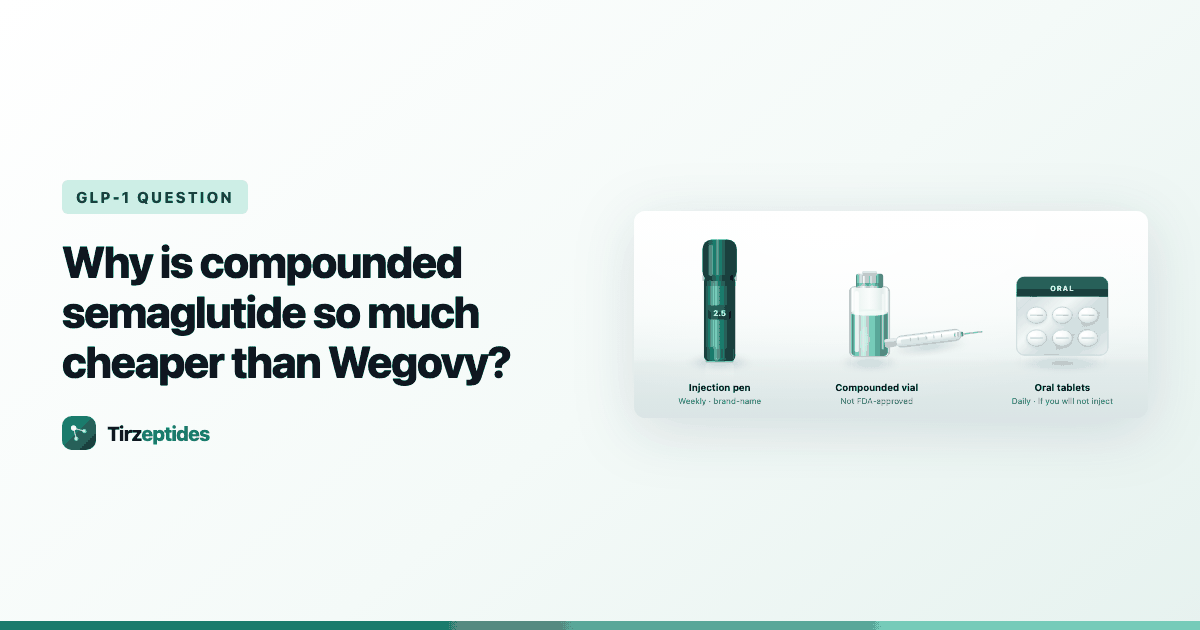
Because almost everything that makes a brand-name drug expensive has been removed — and one of the removed things is FDA review.
Across the providers we track, published compounded semaglutide runs $99 to $199 a month. Brand-name cash-pay pricing sits far above that. The gap is not a discount on the same product; it is a different product, made under different rules, with a different set of guarantees behind it.
This is not medical advice. Tirzeptides is an independent comparison site, not a healthcare provider. Nothing here creates a doctor-patient relationship or replaces a conversation with a licensed clinician. GLP-1 medications are prescription drugs with real risks and contraindications. Talk to a qualified provider before starting, stopping or changing any treatment.
Where the brand-name price actually goes
A manufacturer's list price is not the cost of making the molecule. Semaglutide is a peptide; the active ingredient is not the expensive part. The price carries:
- Clinical trial programmes. STEP, SUSTAIN, SELECT and the rest ran for years across thousands of participants. That evidence is why anyone knows what the drug does — and the company that paid for it recovers that cost through the price.
- Regulatory approval. Manufacturing is inspected, batches are validated, adverse events are tracked and reported.
- Patent exclusivity. No generic competition, so the price is set by what the market and insurers will bear rather than by production cost.
- Distribution and rebates. Wholesalers, pharmacy benefit managers and rebate structures all take a cut of the list price, which is one reason list price and what anyone actually pays diverge so widely.
- Marketing. Direct-to-consumer advertising for this category has been enormous.
What the compounded price leaves out
A compounded preparation skips most of that stack:
- No trial programme to recover. Compounders rely on the evidence generated by the original manufacturer without having paid for it.
- No FDA approval process. Compounded drugs are not reviewed by the FDA for safety, effectiveness or manufacturing quality. This is the single most important line on this page.
- No patent premium. Compounders are not pricing against exclusivity.
- No middlemen. Telehealth sells direct, so there is no wholesaler margin and no PBM rebate layer.
- No insurance billing. Cash-pay only, which removes an entire administrative apparatus — and is why the advertised number is the number.
Add to that the commercial reality: these providers compete with each other on a published price, which drags prices down in a way brand-name drugs sold through insurance never experience.
HealthRX
Best overall · scored 8.2/10
$99/mo semaglutide on a 12-month plan
- LegitScript-certified (certification #50087439)
- Among the lowest per-month pricing on this list
- Same price at every dose level
What you are giving up for the difference
The honest trade is not "same drug, lower price". It is:
- No FDA verification of what is in the vial. Potency and purity depend entirely on the compounding pharmacy's own standards. Quality between compounders is not uniform.
- No approved-product safety monitoring. The post-market surveillance attached to an approved drug does not cover a compounded one.
- Regulatory uncertainty. The shortage justification that opened this market has ended, and the FDA has proposed closing the bulk-compounding route entirely — see is compounded semaglutide still legal. That risk is real and it is the main argument against prepaying for twelve months.
- Dosing that may not match. Compounded products sometimes come in concentrations that do not map onto the approved titration schedule.
Is the cheapest option the best value?
Not automatically, and the pricing structure is where most people get caught. The headline figure is usually the twelve-month prepaid rate. The month-to-month rate at the same provider is often $40–$80 higher, and the advertised "from" price may be a first-month or promotional rate set against a much higher ongoing one.
Since most people who stop do so in the first weeks — usually over side effects — a twelve-month prepayment to save $40 a month is a bet that you will tolerate a drug you have not started yet. Starting monthly and moving to a longer plan once you know how you respond costs a little more and removes that risk entirely.
Every published price, by provider and plan length, is on our GLP-1 price index.
The short version
The gap is structural: no trial costs, no approval process, no patent premium, no middlemen, and direct price competition. Most of those are genuinely just cost that has been stripped out. One of them — the absence of FDA review — is a guarantee you are giving up, not a saving. Price the two accordingly rather than treating them as the same product at two prices.
Sources
- Human Drug Compounding Policies and Rules — U.S. Food and Drug Administration
- FDA Proposes to Exclude Semaglutide, Tirzepatide, and Liraglutide on 503B Bulks List — U.S. Food and Drug Administration
- Semaglutide — StatPearls — NIH National Library of Medicine
Our top three, compared
Ranked by the six published weights on how we rank. All three are paid partners.
Related questions
- Which GLP-1 is best for weight loss?
- Which GLP-1 is best for cardiovascular benefit?
- What does GLP-1 do in the body?
- How long do GLP-1 side effects last?
- How fast does GLP-1 weight loss happen?
All GLP-1 questions answered → · GLP-1 price index → · Compare the 8 providers →