Microdosing GLP-1s: What It Is and Who It Actually Helps
Lower doses than the approved schedule, offered by compounded providers. For some people it solves a real tolerability problem. For others it is a way to sell a weaker product.
What it means
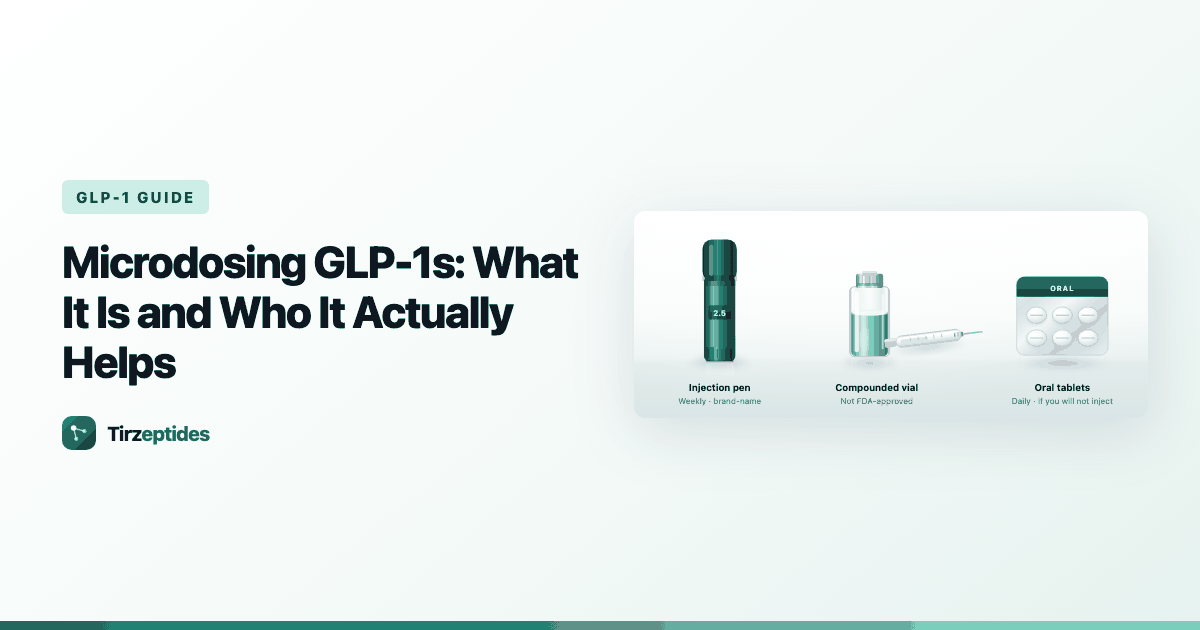
Microdosing means taking a GLP-1 at doses below the approved escalation schedule — often a fraction of the standard starting dose — either indefinitely or as a slower on-ramp.
This is only possible with compounded medication. Brand-name products come in fixed approved strengths. A compounding pharmacy can prepare any concentration, which is why Bodybuilding Health+ and Gala Health can offer microdosing and manufacturer channels cannot.
Why people want it
- Tolerability. Some people get severe nausea even at the lowest standard dose. A lower dose can make treatment possible at all.
- Maintenance. After reaching a goal weight, some prefer a lower dose to hold position rather than stopping entirely and regaining.
- Cost. Less drug generally costs less.
- Preference. Some people want appetite moderated rather than switched off, and want to keep eating enough protein to protect muscle.
Bodybuilding Health+
Clearest pricing ladder · scored 8.0/10
Save $480 a year on a 12-month plan
- Clear tiered pricing published for every bundle length
- Microdosing protocols available for people who want lower doses
- Wide catalogue: NAD+ and sermorelin from $129/mo, PT-141, glutathione, GHK-Cu
What the evidence says
Be clear about this: microdosing protocols are not what the pivotal trials studied. SURMOUNT and STEP tested specific escalating doses to specific targets, and the weight-loss figures everyone quotes come from those schedules. There is no equivalent trial evidence for microdosing.
The pharmacology makes partial effects plausible — these drugs work on a dose-response curve, and a smaller dose producing a smaller effect is unsurprising. But plausible is not the same as demonstrated, and anyone presenting microdosing as an equally effective route to the headline weight-loss numbers is going beyond the evidence.
The trade-offs
| Argument for | Argument against |
|---|---|
| May make treatment tolerable for people who cannot handle standard doses | No trial evidence for efficacy at these doses |
| Lower cost per month | May cost more per pound lost |
| Potentially useful for maintenance | Only available compounded, so not FDA-approved |
| Gentler appetite suppression may protect protein intake | Under-dosing can look like non-response and lead people to quit |
Who it genuinely suits
The strongest case is someone who has tried a standard starting dose and could not tolerate it. The choice there is not microdose versus standard dose, it is microdose versus nothing.
The second reasonable case is maintenance after reaching a goal, under the supervision of a provider who is actually monitoring you.
The weakest case is starting on a microdose because it is cheaper, with the expectation of trial-level results. That is a mismatch between what you are buying and what you are hoping for.
Read our compounded vs brand-name guide before choosing this route, and make the decision with a prescriber who knows your history.
Our top three, compared
Ranked by the six published weights on how we rank. All three are paid partners.
Related guides
- Tirzepatide vs Semaglutide: What the Head-to-Head Trial Actually Found
- Compounded vs Brand-Name GLP-1: Cost, Legality and What Actually Differs
- How Much Does Tirzepatide Cost in 2026? Every Route Priced
- GLP-1 Side Effects and Who Should Not Take Them
- How to Get Tirzepatide or Semaglutide Without Insurance
- The 8 best GLP-1 providers, compared