Compounded vs Brand-Name GLP-1: Cost, Legality and What Actually Differs
Compounded GLP-1s cost a fraction of the brand-name price. Understanding why, and what changed when the FDA declared the shortages over, tells you what you are actually buying.
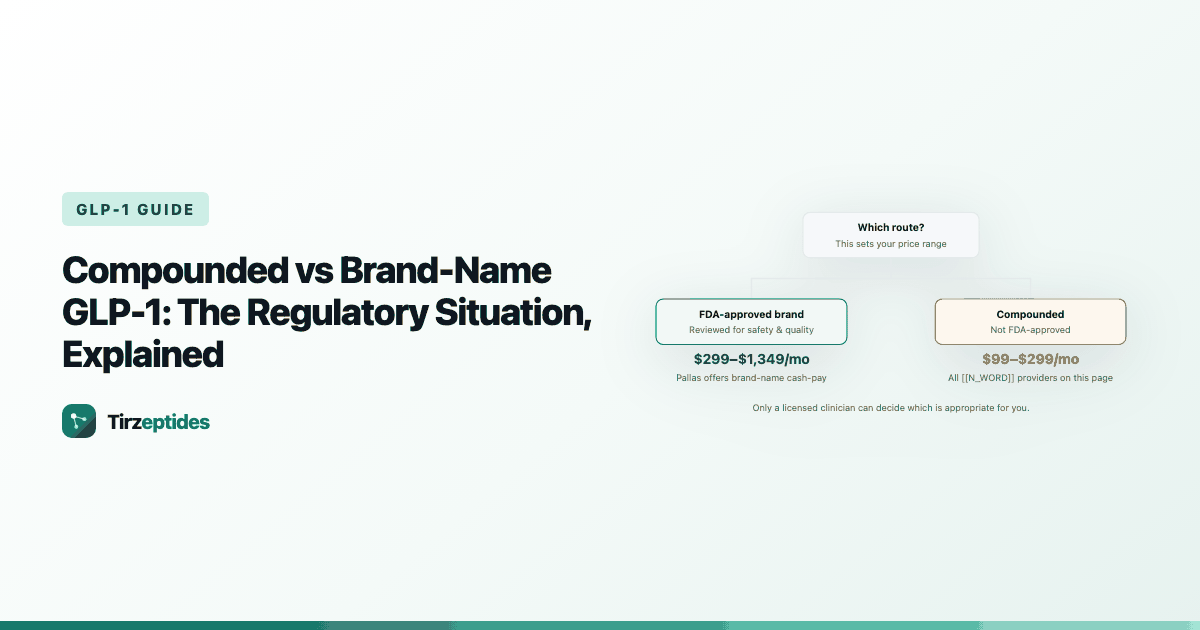
What compounding is
A compounding pharmacy prepares a medication for an individual patient rather than manufacturing a standardised product. Compounding is legal, long-established and legitimate. It exists so that a patient who needs a different dose, a different form or a formulation without a particular allergen can get one.
Crucially, compounded drugs are not FDA-approved. The FDA does not review them for safety, effectiveness or quality before they reach patients. That is not a loophole; it is the defining characteristic of the category. Every provider on our list is required to tell you this, and the honest ones do so prominently.
Why compounded GLP-1s became widespread
Federal law restricts compounding copies of commercially available approved drugs. There is an exception: when a drug is on the FDA's official shortage list, compounders may prepare versions of it.
Semaglutide and tirzepatide were both on that shortage list through the demand surge of 2023 and 2024. That opened the door, and a large compounded GLP-1 telehealth industry grew through it very quickly.
What changed
The FDA removed tirzepatide from the shortage list in December 2024 and semaglutide in February 2025. Once a shortage is resolved, the exception that permitted large-scale compounding closes, and compounders were given wind-down periods running through 2025.
Compounded GLP-1s did not disappear. Many providers continue to operate on the basis that they are supplying personalised formulations — different doses, different concentrations, or combinations with additives such as B12 — which sit in a different regulatory category from straight copies. Whether any particular product genuinely qualifies is contested, and enforcement has been active.
The consequence for you is concrete. In March 2026, Hims & Hers settled with Novo Nordisk and stepped back from routine compounded semaglutide. Older comparison articles quoting $99-a-month compounded semaglutide from Hims are describing a route that is no longer generally open.
Bodybuilding Health+
Clearest pricing ladder · scored 8.0/10
Save $480 a year on a 12-month plan
- Clear tiered pricing published for every bundle length
- Microdosing protocols available for people who want lower doses
- Wide catalogue: NAD+ and sermorelin from $129/mo, PT-141, glutathione, GHK-Cu
The practical trade-off
| Brand-name | Compounded | |
|---|---|---|
| FDA review | Approved for safety, effectiveness and quality | Not FDA-approved or evaluated |
| Typical monthly cost | $299–$1,349 | $99–$299 |
| Potency consistency | Manufactured to approved specification | Depends on the individual pharmacy |
| Dose flexibility | Approved strengths only | Custom doses and microdosing available |
| Supply stability | Stable | Exposed to regulatory and legal action |
How to reduce the risk if you go compounded
- Check for LegitScript certification. It is an independent standard for online pharmacies and telehealth. Of the providers we reviewed, Pallas Health and HealthRX hold it.
- Ask which pharmacy fills your prescription and whether it is a 503A or 503B facility. 503B outsourcing facilities are subject to more stringent standards and FDA inspection.
- Be wary of additives. Formulations combined with B12 or other additives are sometimes used to argue the product is not a copy. That is a regulatory argument, not a clinical benefit to you.
- Have a plan if supply stops. Enforcement can end a supply route quickly.
- Prepay cautiously. A 12-month prepaid plan is a bet on the provider still operating in 12 months.
Our position
We rank compounded providers because that is the market our partners operate in, and we say so plainly on every page. We label FDA-approval status everywhere it matters, and we do not present compounded products as equivalent to approved ones. See our provider comparison for current pricing.
Questions people ask about this
- Which GLP-1 is best for weight loss?
- Is compounded semaglutide still legal?
- Why is compounded semaglutide so much cheaper than Wegovy?
- Does compounded GLP-1 need to be refrigerated?
- Is there an oral GLP-1?
Our top three, compared
Ranked by the six published weights on how we rank. All three are paid partners.
Related guides
- Tirzepatide vs Semaglutide: What the Head-to-Head Trial Actually Found
- How Much Does Tirzepatide Cost in 2026? Every Route Priced
- GLP-1 Side Effects and Who Should Not Take Them
- Microdosing GLP-1s: What It Is and Who It Actually Helps
- How to Get Tirzepatide or Semaglutide Without Insurance
- The 8 best GLP-1 providers, compared